
Saradiel Gramaraj System of Governance
Mahasammata in Action
The Mahasammata President’s role is to set the standard for living in dhamma for the nation. The village council members and the Gramaraj will demonstrate Mahasammata in action at local level.
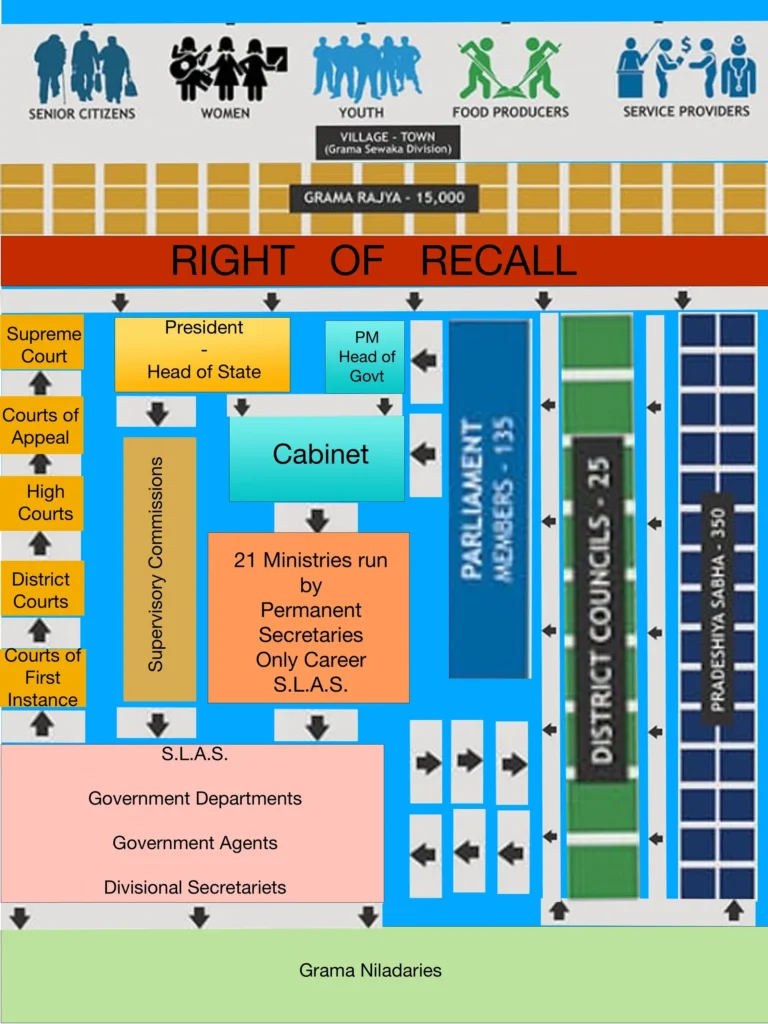
The Executive is vested in the village councils, making about 75,000 people, executed on their behalf by a largely ceremonial president who functions to sign laws into existence but also on behalf of and in consultation with the Gramaraj, overseeing the supervisory commissions, like the Police Commission, the Human Rights Commission, the Judicial Services Commissions, etc., etc. The President also has the right of referral to the Gramaraj for a larger mandate for any legislation he deems necessary.
The Legislature is Parliament, whose members elect from amongst themselves a prime minister who commands the confidence of the house.
The Judiciary is independent, with the Administrative Services appointing judges up to the High Court and District Courts levels, with the Appellate Courts and the Supreme Court judges being elected by the Gramaraj through the President from the Judicial Service.
One of the problems Sri Lanka is facing is the politicization of the civil service. The political secretaries of the ministers become the secretary of the ministry, with the senior civil service either spending their careers in purgatory or becoming useful to politicians to secure their positions. More often outsiders are parachuted in by the party in power. We want to change that to making sure that the civil service positions are only filled by SLAS officers. The same principle will apply to the Foreign Service, with envoy positions only going to the Diplomatic Service.
The Gramaraj elects from within its members the members of Parliament, the urban councils, and the district councils. The Gramaraj retains a right of recall over the people it elects. Each Grama Nildadari area elects five members to the Gramarj by sector. Each G.N. area represents roughly 1500 people, which is about 300 people per sector. One needs only to campaign across one’s G.N. area, and so the cost of running a campaign is limited and localized. This is a brilliant idea of Navin’s original design. The provincial councils may be done away with as the Gramaraj will fulfill that function. The Saradiel movement suggests we redraw districts by watershed, as set out in A Survey of Ancient Water Works by A. Denis Fernando.
The independence of the SLAS is ensured by the Supervisory Commissions reporting directly to the Gramaraj through the President. By forbidding political parachutists into the SLAS and appointing civil society to those commissions, we ensure freedom from political interference as well as prevent rule by Mandarin.
This schematic is an adaptation of the schematic of the Movement for a United Motherland by Navin Guneratne et al.